
Funded by the European Union. Views and opinions expressed are however those of the author(s) only and do not necessarily reflect those of the European Union or the European Education and Culture Executive Agency (EACEA).
Funded by the European Union. Views and opinions expressed are however those of the author(s) only and do not necessarily reflect those of the European Union or the European Education and Culture Executive Agency (EACEA).

FLORENCE – On February 16, 2026, the city of Florence became a hub for European digital innovation as it hosted two major "Multiplier Events" for the DESIRE (Digital Education Skills in Rural Europe) project. Funded by the Erasmus+ program, the initiative aims to bridge the digital gap in rural areas through a strategic partnership between Familles Rurales (France), Pixel, and Pegaso (Italy).
A Day of Strategic Cooperation
The morning session kicked off at the Pixel offices, where 13 international representatives from various institutional partners gathered to review the project’s progress. The focus was on the strong synergy between the European partners and the successful management of the project’s milestones.
In the afternoon, the spotlight shifted to the Centro Machiavelli, a prestigious Florentine center specializing in adult education and innovative teaching. This historic venue provided an ideal setting for educational professionals to discuss how to better support communities facing digital isolation. 17 people attended the event.
Key Tools for Digital Mediators
Both sessions focused on the presentation of the project’s two flagship results:
• The Compendium of Best Practices: A comprehensive analysis of successful digital adult education practices currently operating in France and Italy.
• The Online Toolkit: A multilingual digital toolkit offering practical pedagogical tools and guidance for mediators working in the field.
A Successful Round Table
Designed as a series of dynamic round tables, the events encouraged active participation, allowing attendees to share unique perspectives and broaden the project’s impact. The day proved to be a significant success in terms of dissemination, fostering new professional networks and reinforcing a shared European commitment to ensuring that rural residents are not left behind in the digital age.
The DESIRE Project Reaches Completion: Three Milestones to Transform Rural Digital Education
The series of transnational meetings for the DESIRE project has officially concluded. This European initiative was launched with the goal of breaking down digital barriers and providing innovative tools for trainers operating in rural areas.
A Three-Stage Journey
The partners' journey began in November 2024 in Angers, France, where partnership members (including Familles Rurales and Pixel) met in person for the first time. That meeting laid the groundwork for the Compendium of Good Practices, enriched by site visits to local organizations such as "France Service" and "Point de Médiation Numérique."
The second milestone took place in May 2025 in Florence, Italy. During this session at the Pixel offices, the group refined the Compendium and officially introduced the Toolkit for Adult Trainers, sharing expertise with sector specialists like Glocal Factory to enhance educational methodologies.
The Final Achievement
On December 11th and 12th, 2025, Familles Rurales hosted the final act of the project. During this third transnational meeting in Angers (FR), the partners proudly presented the final outputs:
The Compendium of Good Practices: A curated collection of successful models in digital education.
The Toolkit for Trainers: A practical resource designed to support the teaching of digital technologies to adults.
The event culminated in the final conference organized by Familles Rurales, a crucial moment for sharing project successes with stakeholders and discussing foundations for future European collaborations. With the review of dissemination activities and the final report planning underway, the DESIRE project draws to a close, leaving behind a tangible legacy for digital inclusion across Europe.

Digital Divide in Rural Areas: DESIRE Project Final Conference Held in Angers
ANGERS (France) – The final conference of the European project DESIRE (Digital Education Skills In Rural Europe) took place on December 11th in Angers. The event marked the culmination of an international cooperation journey aimed at combating the digital divide in rural territories and promoting inclusion through education.
A Bridge Between France and Italy
The project, co-funded by the Erasmus+ program, involved close collaboration between French and Italian actors. Coordinated by the Fédération Régionale Familles Rurales des Pays de la Loire, the partnership included the Departmental Federation of Maine-et-Loire and, representing Italy, the Pixel association and the Pegaso network from Florence.
The central objective of the initiative was twofold:
To foster the sharing of experiences between institutional and associative actors.
To strengthen the skills of digital mediators, both salaried staff and volunteers.
Results Presented: Concrete Tools for Inclusion
During the conference, the main results (deliverables) of the joint work were presented and are now available in English, French, and Italian:
A collection of best practices for digital education specifically for rural zones.
An online toolkit designed for digital mediators operating in isolated areas.
All materials are accessible via the official project platform: desire.pixel-online.org.
Comparison and Future Perspectives
The event in Angers was also a crucial moment to analyze the differences and similarities between the two countries. Although both share programs of similar duration and offer free access for users, structural differences emerged: while France relies on dedicated national funding for mediators, Italy is currently benefiting more from "Next Generation EU" funds.
Particular interest was sparked by the French model of "itinerant vans" (mobile units), identified as an ideal solution for reaching the most geographically isolated people and revitalizing digital mediation points. For the partners from Tuscany, the meeting was an opportunity to study the strong territorial anchorage of Familles Rurales and the involvement of volunteers—a model that could be successfully replicated in Italy.
The conference confirmed that, despite organizational differences, transnational cooperation remains the key to developing innovative pedagogical tools and ensuring no one is left behind in the digital transition.
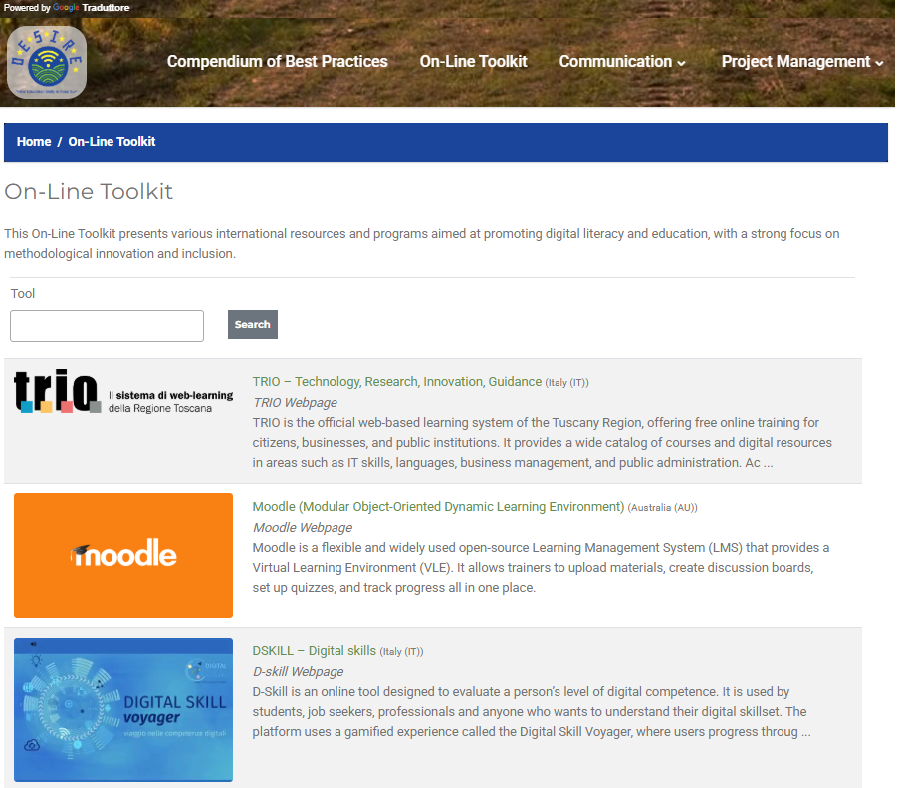
On-Line Toolkit for Digital Education Published by DESIRE Project
The DESIRE project consortium announces the release of its "On-Line Toolkit," which is now accessible through the project website. This resource provides practical guidance tailored for delivering digital courses to adults.
The Toolkit features detailed descriptions of various learning tools, clearly outlining their objectives, intended target groups, estimated duration, and step-by-step pedagogical processes. Developed to support adult trainers and education centers, the resource is published in English, French, and Italian, ensuring broad accessibility and facilitating its dissemination across European contexts.

DESIRE Project Partners Finalize Preparations for Upcoming Events
The DESIRE project partners, including representatives from Pixel, Pegaso, Familles Rurales 49 (FD49), and Familles Rurales Pays de la Loire, held an online meeting to coordinate the final stages of the project and upcoming activities.
Key decisions and action points resulting from the meeting include:
Physical Attendance to the next TPM: Elisabetta Delle Donne (Pixel), Roberta Solinas, and Cathia Patronella (Pegaso) will attend the partnership meeting scheduled to take place in Angers on December 11th and 12th.
Final Conference Presentations: At the project's final conference, Pixel and Pegaso will each deliver a 10-minute presentation focusing on their respective organizations' activities relevant to the DESIRE project.
Workshop Animation: The partners agreed on the plan for the workshop focusing on Italian practices. Elisabetta Delle Donne will lead the session, supported by Alexandre, Luc Bénard, Roberta Solinas, and Cathia Patronella.
Online Toolkit Updates:
All partners are asked to provide feedback on the online toolkit via email before the end of November. They also have the credentials to make direct modifications if necessary.
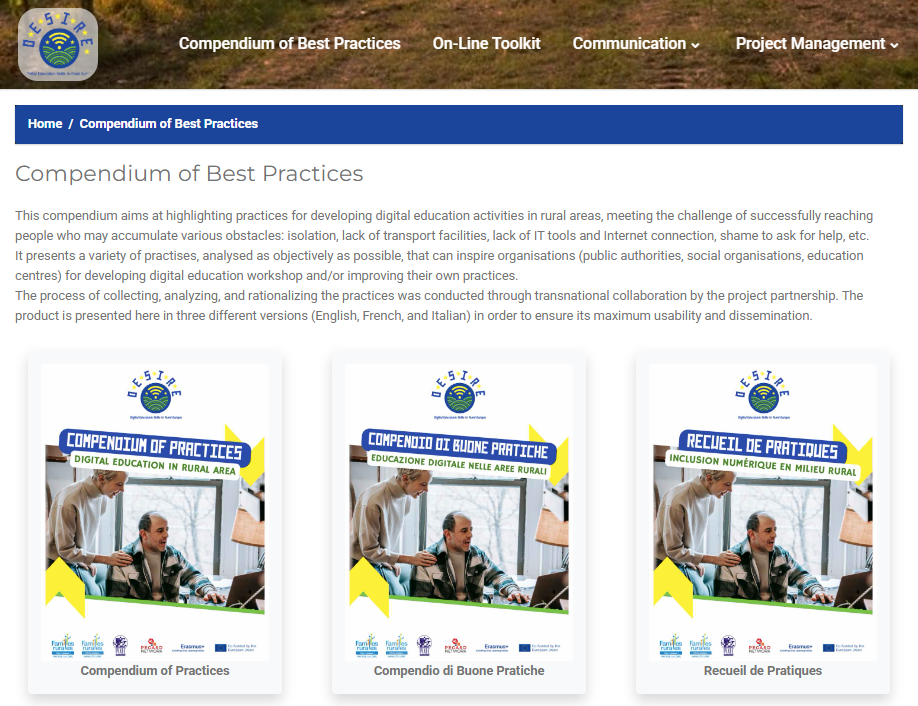
Compendium of Best Practices on Digital Education in Rural Areas Published
The DESIRE project consortium announces the publication of the "Compendium of Best Practices," which is now available on the project website. This document aims to highlight effective practices for delivering digital education activities in rural areas, directly confronting the challenge of successfully reaching individuals who often face multiple obstacles, including geographical isolation, lack of transport and IT tools, poor internet connection, and reluctance to ask for assistance.
The Compendium presents a variety of practices, analyzed as objectively as possible, designed to offer inspiration for organizations—such as public authorities, social organizations, and education centers—looking to either develop new digital education workshops or improve their current methodologies. The content, which results from a transnational collaboration process by the project partnership, is provided here in three different versions (English, French, and Italian) to ensure maximum usability and wider dissemination.

The home straight before the publication of the compendium of good practice in digital education!
In June, the DESIRE project partners met by videoconference to discuss a number of issues.
Firstly, the finalisation of the compendium of good practice, which is currently being translated and will be formatted in the coming weeks for dissemination in mid-July.
We then discussed our next meeting in Angers, France, which will take place on 11 and 12 December. We will be holding the final conference of the DESIRE project on the evening of 11 December. Stay tuned!

In May, all DESIRE project partners gathered in Florence for the second face-to-face meeting . These two days of work were rich and productive, enabling us to make further progress on our collection of practices.
Over the last few months, each partner has mobilised its network to collect testimonials and feedback on different digital practices in rural areas. This fieldwork has enabled us to gain a better understanding of the implementation of these initiatives in France and Italy. We then identified the main similarities and differences, before organising them according to collectively-defined criteria, with the aim of making our guide clear, readable and accessible to as many people as possible.
The compendium of practices will be completed in English by mid-June. It will then be formatted and translated into French and Italian before dissemination
Inspiring meetings
In Florence, we also had the opportunity to meet two of Pixel and Pegaso's Italian partner structures:
Better Social : an inclusive digital agency offering training courses in the digital field (such as digital communication), aimed at people with disabilities. It supports its learners throughout their career, from training to professional integration.
Glocal Factory : a cooperative engaged in the design and implementation of projects and training linked to education, innovative learning, entrepreneurship, social inclusion and the integration of migrants. It supports social economy organisations to meet the needs of local communities and promote a more inclusive future.
These exchanges enabled us to discover inspiring practices and gain a better understanding of how associations and cooperatives work in Tuscany, and more widely in Italy.
Next step: our Online Toolkit
The meeting also marked the start of our second deliverable: an online toolkit for digital education professionals. Over the coming months, each partner will select 4 or 5 practices, according to common criteria, which will then be integrated into this online platform.
Conviviality at the heart of the Florentine meeting
Last but not least, the meeting was also punctuated by convivial moments such as a shared dinner and a tour of Florence, which all participants seemed to enjoy. A great team dynamic to keep the project moving forward!

For our March meeting, we welcomed several members of the ANCT (Agence Nationale de la Cohésion des Territoires - French National Agency) who came to talk to us about their digital-related activities. This agency supports local authorities in reducing the digital divide and developing digital services adapted to local needs. In terms of the DESIRE project, this meeting enabled us to highlight potential links between this structure and our project.
We also took advantage of the meeting to review progress on the Compendium of practices and the various testimonials and interviews that we plan to analyse in April.
Our next meeting is scheduled for beginning of May, in Florence!

The DESIRE project partners met in January and February. This was an opportunity to take stock of our communication tools, but also, to review the progress of our work on collecting practices . Some fifteen organisations have already responded to our survey on digital education practices in rural areas. We are continuing to process the information gathered and will now be conducting more detailed interviews to present it in our "Compendium of Good Practices" in the Summer of 2025.
This meeting was also an opportunity to start planning our next meeting in Florence in May 2025.

In December, the DESIRE partners kept working on the methodology used to create our Compendium of good practices.
This questionnaire is made for organisations working in the field of digital education. This questionnaire is now finalised !
During a virtual meeting, each partner took time to present inspiring actions found in its territory.
Those actions will then be questioned about their approach using a questionnaire drawn up together. The final aim is stlll to index them into the Compendium of good practices we would disseminate during next summer.
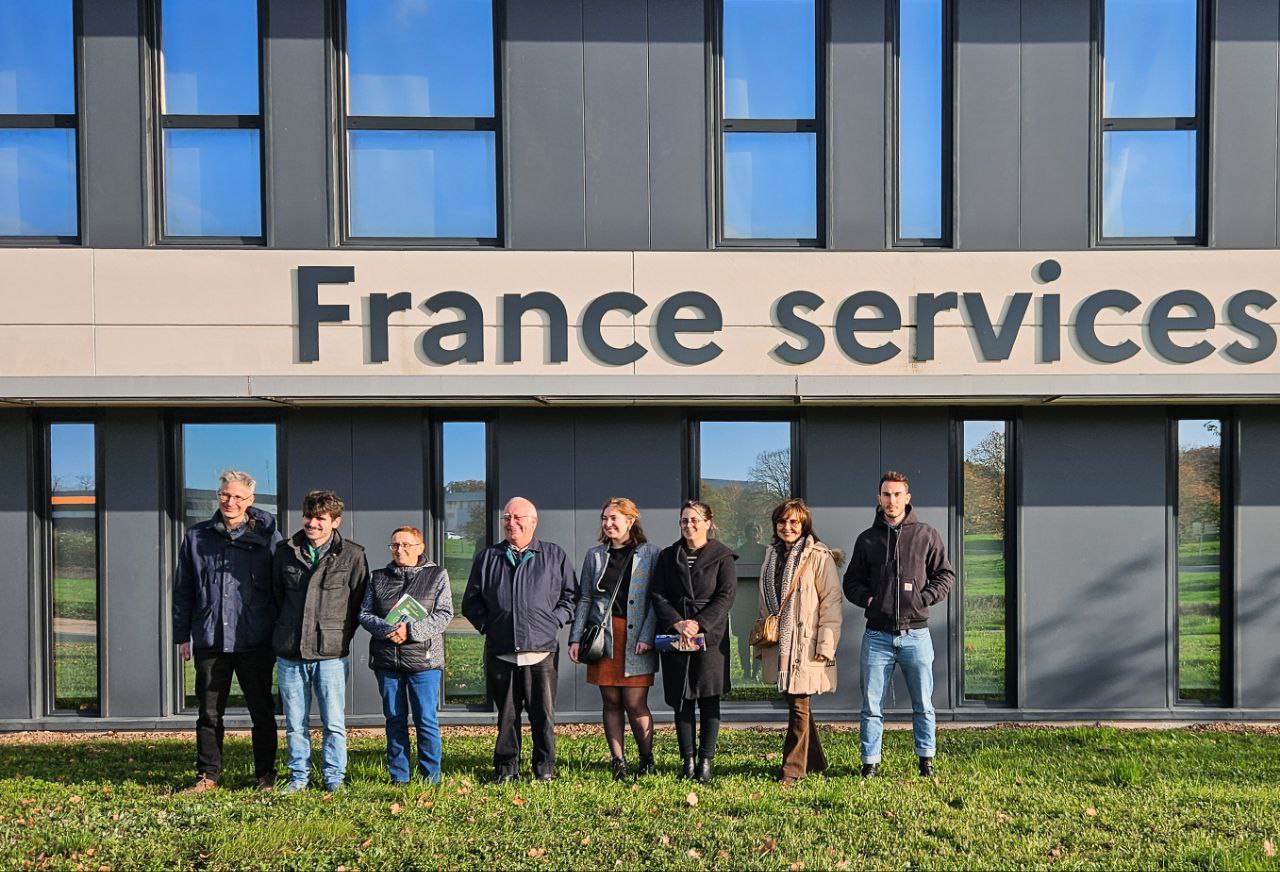
November 14th and 15th, DESIRE partners meet in person for the first time!
This was the first of our 3 face-to-face meetings planned during the project.
The meeting, organised by the two the Familles Rurales partnership members, took place in Angers.
The 14th November morning, we took time to learn to know each other before we started to work on the compendium of good practices, our first project production.
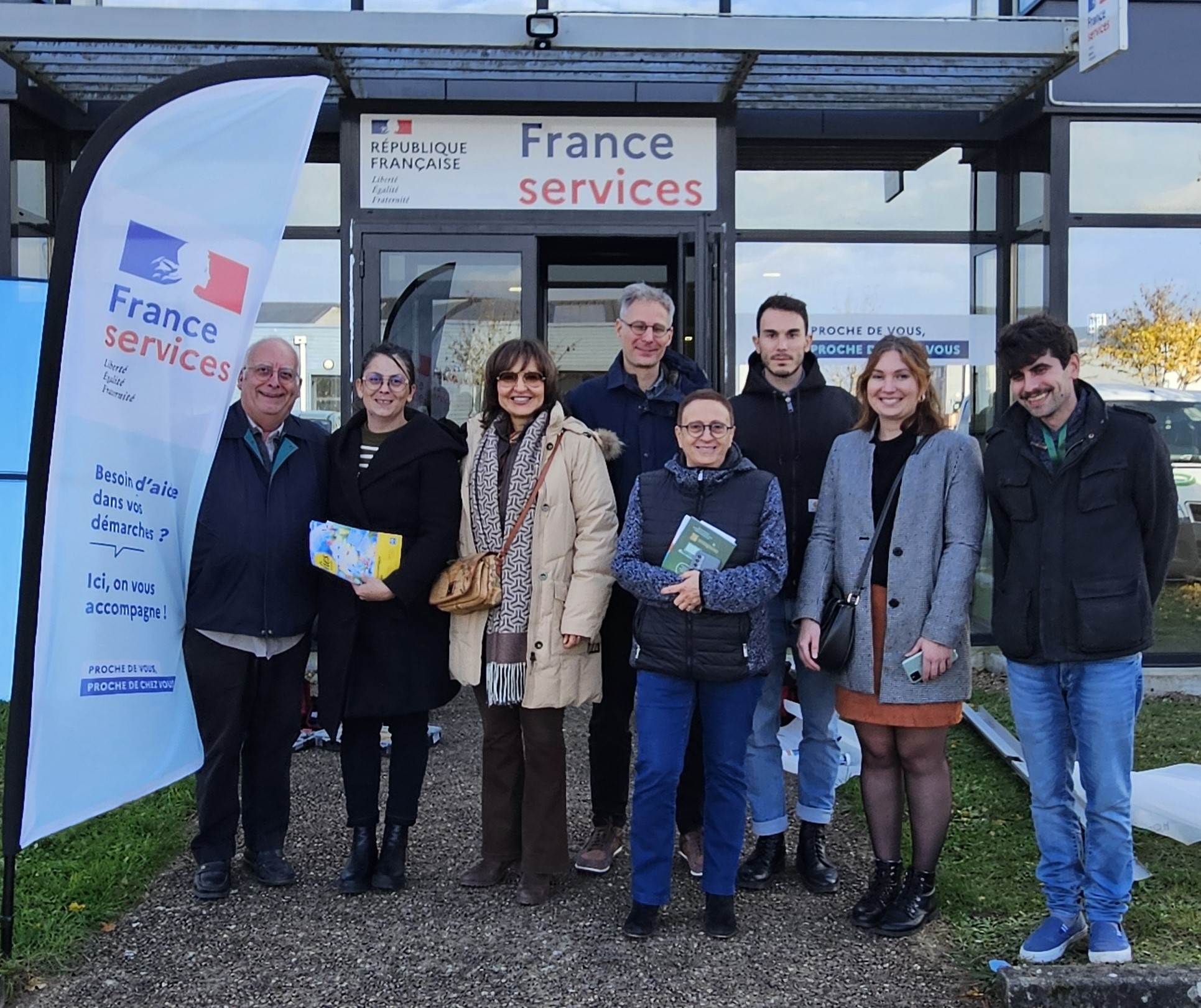
The afternoon, we visited two different organisation that work on digital inclusion in rural area (a “France Service”, a building in a rural sector gathering different public services, and a “Point de Médiation Numérique” where people can be supported for the online administrative procedures or participate in information technology courses).
The next day, Familles Rurales organised a meeting with local partners involved in digital education to benefit from their experience for the project. We then worked on practical details and scheduled the next activities and meetings to make the project implementation successful.
Those two days were a great opportunity to share convivial moments and, for the Italian partners, to discover Angers and the surrounding area.
We will meet again in face to face in Florence in May 2025!
The kickoff meeting of the European project DESIRE – Digital Education Skills In Rural Europe took place on 14–15 November 2024 at the Fédération Régionale des Pays de la Loire in Angers, France. This European initiative, written and coordinated by the project applicant Fédération Régionale des Pays de la Loire (France), brings together a transnational partnership to address digital inclusion in rural areas. Funded under the Erasmus+ Programme, Small-scale Partnerships in Adult Education, the DESIRE project aims to enhance practices in digital education by identifying, analyzing, and sharing effective strategies.
During the first meeting, European Project Partners introduced themselves and their activities. Discussions focused on the Compendium of Good Practices in Digital Education, setting the stage for upcoming project activities.